

Complexity at the Fundamental Level of our Knowledge (PDF) 2012
Deceased Academicians
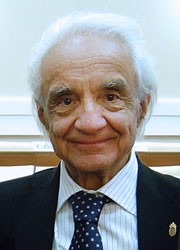
Most important awards, prizes and academies
Many honours and awards have been conferred upon Antonino Zichichi for his outstanding discoveries and inventions and for his contributions to the promotion of Science and Scientific Culture in Italy and abroad. He is the recipient of over 105 prizes and honorary awards among which: Doctor Honoris Causa in the Universities of Beijing, Buenos Aires, Malta, Bucharest, Arizona. Academies: Academy of Sciences of the Ukrainian Republic; Academy of Sciences of Georgia; Bologna Academy of Sciences. Honours: Order of Merit of the Republic of Poland; Order of Merit of the Federal Republic of Germany; Order of Merit of the Italian Republic; Gold Medal for Science and Culture of the President of the Italian Republic. For his discovery of Nuclear Antimatter the Italian Physical Society awarded him, in 2001, the Enrico Fermi Prize, established to celebrate the centennial anniversary of the birth of the great Italian physicist. He founded and directs the Ettore Majorana Centre for Scientific Culture, the first example of the University for the Third Millennium, making Erice famous worldwide. He is past President of the INFN (Italian National Institute for Nuclear Physics), of the EPS (European Physical Society), of the NATO Science Committee for Disarmament Technology (nuclear, chemical, bacteriological and conventional) and of the Enrico Fermi Centre, Rome. He is President of the World Federation of Scientists (1973) and of the World Laboratory (1986).
Summary of scientific research
Antonino Zichichi is the author of studies and research into the structure of the elementary building blocks and of the fundamental forces of Nature. He has published over 500 scientific papers, some of which have opened new avenues in Subnuclear Physics at High Energies, and has to his credit: the discovery of Nuclear Antimatter [1]; the conjecture of the existence of a Third Lepton [2] and the invention of new technologies [3-4] which led to the discovery of the Third Family in the structure of the fundamental particles [5]; the first direct measurements of the mixing angles in pseudoscalar [6] and vector mesons [7] [8]; the discovery of the 'time-like' electromagnetic structure of the proton [9]; the discovery - in the forces which act between quarks and gluons - of the Effective Energy [10]; the proof that, despite its complex structure, it is impossible to break the proton [11], the ultimate heavy building-block of the Universe; the phenomenological discovery of the EGM effect which lowers by three orders of magnitude the supersymmetry breaking threshold energy [12]. At the present time he is engaged in a series of new experiments [13]; at CERN (Geneva), he directs the LAA project [14] and the TOF project of the ALICE experiment for LHC; at DESY (Hamburg), he takes part in the HERA ZEUS experiment; at Gran Sasso, he directs the LVD experiment.
Main publications
[1] Massam, T., Muller, Th., Righini, B., Schneegans, M. and Zichichi, A., Experimental Observation of Antideuteron Production, Nuovo Cimento, 39, p. 10 (1965); [2] Zichichi, A. et al., A Proposal to Search for Leptonic Quarks and Heavy Leptons Produced by ADONE, INFN/AE-67/3, 20 March 1967; Zichichi, A. et al., Limits on the Electromagnetic Production of Heavy Leptons, Lettere al Nuovo Cimento, 4, p. 1156 (1970); Zichichi, A. et al., Limits on the Mass of Heavy Leptons, Nuovo Cimento, 17A, p. 383 (1973); [3] Massam, T., Muller, Th. and Zichichi, A., A Telescope to Identify Electrons in the Presence of Pion Background,CERN Report 63-25, 27 June 1963 and Nuovo Cimento, 39, p. 464 (1965); Zichichi, A. et al., Un Grand Détecteur E.M. à Haute Réjection des Pions, Revue de Physique Appliquée, 4, p. 108 (1969); Zichichi, A. et al., A Large Electromagnetic Shower Detector with High Rejection Power Against Pions, Nuclear Instruments and Methods, 101, p. 433 (1972); [4] Zichichi, A.et al., Range Measurements for Muons in the GeV Region, CERN Report 64-31, 24 June 1964 and Nuovo Cimento, 35, p. 759 (1965); [5] Wu, C.S., Lee, T.D., Cabibbo, N., Weisskopf, V.F., Ting, S.C.C., Villi, C., Conversi, M., Petermann, A., Wiik, B.H. and Wolf, G., The Origin of the Third Family (C.S. Wu, ed.), a joint publication by University and Academy of Sciences of Bologna, INFN, SIF (1997), World Scientific (1998); [6] Zichichi, A.et al., Evidence for a New Decay Mode of the X0-Meson: X0 -> 2γ, Nuovo Cimento, 58A, p. 289 (1968); [7] Zichichi, A. et al., Observation of the Rare Decay Mode of the φ-Meson: φ->e+e-, Nuovo Cimento, 56A, p. 1173 (1968); Zichichi, A. et al., The Decay Mode ω->e+e- and a Direct Determination of the ω-φ Mixing Angle, Nuovo Cimento, 57A, p. 404 (1968); Zichichi, A. et al., Evidence for the New Decay Mode φ->ηγ, Proceedings of the International Conference on Meson Resonances and Related Electromagnetic Phenomena, Bologna, Italy, 14-16 April 1971 (Editrice Compositori, Bologna, 1972), p. 265; [8] Zichichi, A., An Apparatus of the NBC Type and the Physics Results Obtained, Annals of Physics, 66, p. 405 (1971); [9] Conversi, M., Massam, T., Muller, Th. and Zichichi, A., Search for the Time-Like Structure of the Proton, Phys. Lett., 5, p. 195 (1963); Conversi, M., Massam, T., Muller, Th. and Zichichi, A., The Leptonic Annihilation Modes of the Proton-Antiproton System at 6.8 (GeV/c)2 Timelike Four-Momentum Transfer, Nuovo Cimento, 40, p. 690 (1965); [10] Zichichi, A. et al., Evidence of the Same Multiparticle Production Mechanism in p-p Collisions as in e+e- Annihilation, Physics Letters, 92B, p. 67 (1980); [11] Massam, T. and Zichichi, A., Quark Search at the ISR, CERN (preprint), Geneva, Switzerland, June 1968; Zichichi, A. et al., Search for Fractionally Charged Particles Produced in Proton-Proton Collisions at the Highest ISR Energy, Nuovo Cimento, 40A, p. 41 (1997); Zichichi, A.et al., Search for Quarks in Proton-Proton Interactions at √s = 52.5 GeV, Nuovo Cimento, 45A, p. 171 (1978); Zichichi, A. et al., A Search for Quarks in the CERN SPS Neutrino Beam, Nuovo Cimento, 45A, p. 281 (1978); [12] Anselmo, F., Cifarelli, L., Peterman, A. and Zichichi, A., The Simultaneous Evolution of Masses and Couplings: Consequence on Supersymmetry Spectra and Thresholds, Nuovo Cimento, 105 A, p. 1179, (1992); [13] John Bell and the Ten Challenges of Subnuclear Physics, Presented at the symposium Quantum [Un]Speakables, Erwin Schrödinger Institute, Vienna, 10 November 2000; [14] Zichichi, A.et al., The Main Achievements of the LAA Project, Report No. 7, CERN/LAA/91-1, 1 March 1991. Books: L'Infinito, Rizzoli-Bur (1988 1st ed., 1994 7th ed.), Pratiche Editrice, 6 ed. (1998-2001), and NET (2005); Scienza ed Emergenze Planetarie, Rizzoli (1993 1st ed., 1994 3rd ed.), Supersaggi Rizzoli (1996 1st ed., 1999 7th ed., 2005 23rd ed.); Creativity in Science (1st ed. 1996, World Scientific, 1999; translated into Russian and published by YPCC, Moscow 2001); Subnuclear Physics – The first fifty years, O. Barnabei, P. Pupillo and F. Roversi Monaco eds, a joint publication by the University and the Academy of Sciences of Bologna, Italy (1998); 20th Century Physics Series, Vol. 24, World Scientific (2000-2001); Perché io credo in Colui che ha fatto il mondo, il Saggiatore, 23 editions (1999-2005); Marco Tropea Editore (2009), translated into Portuguese and published by Editora Objetiva Ltda, Rio de Janeiro (2000), translated into French and published by Éditions Salvator, Paris (2003); L'irresistibile fascino del Tempo, il Saggiatore, 5 editions (2000), and NET, 3 editions (2004-2005), Marco Tropea Editore (2011); Antimatter. Past, Present and Future, SIF (2001); Galilei, divin uomo, il Saggiatore, 4 editions (2001-2006), Marco Tropea Editore, two editions (2009-2010), translated into English and published by Italian Physical Society, two editions (2009-2010); Il vero e il falso, il Saggiatore, 4 editions (2003-2006), translated into Chinese and published by Shanghai Scientific & Technical Publishers (2006); Galilei. Dall'Ipse Dixit al processo di oggi. 100 risposte, il Saggiatore (2004); Tra Fede e Scienza. Da Giovanni Paolo II a Benedetto XVI, il Saggiatore, 3 editions (2005-2006), Marco Tropea Editore (2011); Ettore Majorana – His Genius and Long-Lasting Legacy, Italian Physical Society (2007); The Physics of Giampietro Puppi / La Fisica di Giampietro Puppi, WFS (2007); Neither Science nor Civilization Could exist Without Memory. The Science for Peace Erice Prize, WFS (2007); Galileo Galilei’s Genius in all fields of Human Knowledge / La Genialità di Galileo Galilei in tutti i campi dell’Umano Sapere, SIF (2010-2012); Exhibition and Solemn Mass in honour of Galileo Galilei / Mostra e Messa Solenne in onore di Galileo Galilei, SIF (2010-2012); The Cultural Roots of the Work of Art “Galilei Divine Man” donated by the CCAST Scientists to the Basilica / Le Radici Culturali dell’Opera d’Arte “Galilei Divin Uomo” donata dagli Scienziati Cinesi del CCAST alla Basilica, SIF (2011-2012); Giovanni Paolo II il Papa amico della Scienza, Marco Tropea Editore (2011); Giovanni Paolo II nella Storia e nella Scienza, WFS (2011); Progetto Archimede, WFS (2013); Science for Peace the World Over. A New Manhattan Project as a Project for Mankind, Il Cigno GG Edizioni (2015), SIF (2018); A Lesson for the Future of Our Science My Testimony on Lord Patrick M.S. Blackett, World Scientific (2016); Fede, Scienza e Tecnologia, Libreria Editrice Vaticana (2016); La Bellezza del Creato, Il Cigno GG Edizioni (2018).
Antonino Zichichi: A Scientist Who Searched the Cosmos for Traces of the Creator
Antonino Zichichi, an internationally renowned particle physicist, gifted communicator, and a leading figure in European scientific research in the second half of the twentieth century, died on 9 February 2026 at the age of 96. A member of the Pontifical Academy of Sciences since 2000, he stood out as one of the most distinctive voices in Italian science. He consistently affirmed that scientific inquiry does not distance humanity from God but awakens wonder before the profound logic written into the fabric of the cosmos – a conviction he repeated throughout his many books and public interventions. For Zichichi, intellectual humility meant acknowledging that the Author of nature’s logic is wiser than any philosopher, mathematician, or scientist, and that human reason itself is a gift from God.
Born in Trapani in 1929, Zichichi quickly made his mark in the world’s leading research institutions. At CERN in Geneva, he led the team that, in 1965, observed the antideuteron for the first time – an important milestone in the study of antimatter. He also worked at Fermilab in Chicago, contributing significantly to the development of high‑energy physics. Over the course of his career, he held major leadership roles, including the presidency of Italy’s National Institute for Nuclear Physics and the European Physical Society, helping strengthen Europe’s position in subnuclear research.
In 1963, he founded the Ettore Majorana Centre for Scientific Culture in Erice, Sicily, which soon became an international meeting point for scientists, Nobel laureates, and young researchers. It embodied his vision of a scientific culture that remained open to the deeper ethical and cultural questions raised by human knowledge.
Zichichi was a complex and often debated figure within the scientific community. He consistently defended the rational credibility of faith and criticised ideas he believed weakened the scientific method. He was also known for his outspoken stance against astrology and superstition, arguing for a rigorous and intellectually honest scientific mindset.
Beyond his research, he was a popular public educator. With clarity and enthusiasm, he brought scientific ideas into the homes of ordinary Italians, suggesting that behind the laws of nature lies a deeper order and presenting science not merely as an intellectual discipline, but as a human and spiritual journey. In recent years, he had embraced social media as another way to share reflections on the wonder of the universe and the responsibility humanity bears in safeguarding it.
His faith, never hidden, nourished his scientific curiosity. “Science gives everyone great intellectual dignity,” he liked to say, “and it is the instrument that helps us understand that we are made in the image and likeness of the Creator”. These words resonated deeply with many believers seeking a meaningful, non‑ideological bridge between reason and transcendence.
After the death of his wife, Maria Ludovica, in 2024, he entrusted to his writings the memory of a love illuminated by both science and hope – pages that revealed his profound conviction that nothing in creation is ever truly lost.
With the passing of Antonino Zichichi, we lose not only a scientist who helped shape contemporary physics, but also a man who sought to show that the search for truth – whether in science or in faith – is the highest calling of the human intellect. His legacy endures in the research centers he founded, in the students he formed, and in his unwavering belief that “science gives everyone intellectual dignity”.
My Personal Experience on the Scientific Legacy of the 20th Century (PDF) 2010
Rigorous Logic in the Theory of Evolution (PDF) 2008
Complexity and Predictions at the Fundamental Level of Scientific Knowledge (PDF) 2006
Totally Unexpected Discoveries: A Personal Experience (PDF) 2004
Scientific Culture and the Ten Statements of John Paul II (PDF) 2002
CERN Obituary of Prof. Antonino Zichichi